
These books represent the progression of my primary contributions to framing a New Economy grounded in living system principles. Change the Story, Change the Future: A Living Economy for a Living Earth; Agenda for a New Economy, The Great Turning: From Empire to Earth Community; The Post-Corporate World: Life after Capitalism; When Corporations Rule the World, and Getting to the 21st Century defined critical stages in the Forum’s now more than 20 year campaign to change the stories that frame the economic discourse of our time. <See The Forum and the Economic Story Revolution>
Change the Story, Change the Future: A Living Economy for a Living Earth
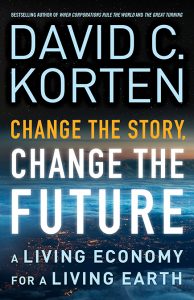 We humans live by our shared framing stories and have a deep need for a sense of purpose and meaning. If we do not share an authentic sacred story, the void will be filed with an inauthentic story – and that is our problem. An economy, a society, built on the foundation of a lie cannot work. This book is a summation of the insights of a lifetime of dramatically varied experiences. My intention is to demonstrate the depth and significance of the contrast between the story by which we currently live and the nature and implications of the story now emerging.
“One of the most thought-provoking analyses of the shifts in Western ideals and modern society now available under one cover.”
Sister Joan Chittister, OSB, Executive Director, Benetvision, and author of A Passion for Life
“Change the Story, Change the Future hands us the keys to a world in which all people live in creative, peaceful, and coproductive partnership with one another and with nature.”
Thom Hartmann, bestselling author and internationally syndicated talk show host.
Agenda for a New Economy: From Phantom Wealth to Real Wealth
A Declaration of Independence from Wall Street
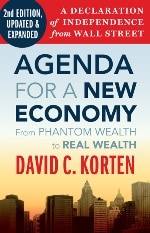
Perhaps the most significant advance is in the treatment of the money system as a system of power and the examination of critical money system design options and their implications. This provides the basis for a more systemic and nuanced treatment of key design choices needed to shift the values focus from money to life and the locus of power from global financial institutions to people and place based communities—call it a transition to real markets and democracy.
“The most important book to emerge thus far on the economic crisis. David Korten provides real solutions.”
— Peter Barnes, cofounder of Working Assts and author of Capitalism 3.0
The Great Turning: From Empire to Earth Community

It became evident following the September 11, 2001 terrorist attack on the World Trade Towers that the global citizen movement that emerged in response to the devastation wrought by corporate globalization needed a larger organizing framework. Events following the attack, drew attention to the fact that the rise of modern corporate power is only a modern manifestation of much deeper psychological, cultural, and institutional forces that have shaped the dominant human societies for 5,000 years. I set about to deepen my understanding of these forces from a spiritual evolutionary and historical perspective. The Great Turning: From Empire to Earth Community was the result.
David Korten never fails to shake me out of my complacency, and reveal complacencies I didn’t even know I had. This work is a stunning and compassionate tour de force, calling on history, science, economics and our human goodwill to illuminate the fact that we are at a fundamental choice point. I can’t stop thinking about the issues he raises nor what I’m going to do with my awakened consciousness. Thank you David.
—Margaret J. Wheatley, author Leadership and the New Science
The Post-Corporate World: Life After Capitalism
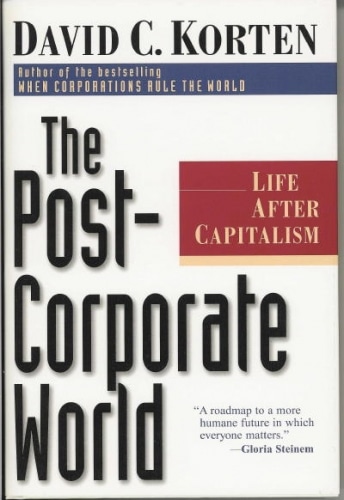
As the emerging global resistance movement against corporate globalization’s assault against democracy, community, and the natural environment gained momentum, it became clear that any individual victory would be only temporary until the life-destructive economic system is replaced by a life-serving system. We needed a compelling framework to demonstrate the power and natural potential of a radically decentralized community rooted economic system that defines a positive alternative to the ills of both capitalism and socialism.
I found the needed framework in insights from a small band of biologists working at the cutting edge of biology who were unraveling the secrets of life’s extraordinary capacity self-organize, innovate, and ever advance the boundaries of the possible. Their path breaking findings about life’s capacity for creative self-organization became the foundation of The Post-Corporate World: Life After Capitalism, which makes the translation from biological systems to economic systems to demonstrate the true potential of rule-based market economies that honor the foundational assumptions of grounded market theory.
Alternatives to Economic Globalization: A Better World is Possible
 The International Forum on Globalization (IFG) played a defining role in exposing the reality of corporate globalization and inspiring the global resistance movement. It was one of my primary affiliations during this period and a major influence on my work. The IFG formed around a shared critique. As that critique gave impetus to popular mobilization around the world, other IFG members joined my call to move beyond resistance and seize the initiative by framing and advancing a positive alternative to the free-trade, market deregulation regime being advanced by the world’s transnational corporations. We decided to produce a book length report presenting such a framework. I was an active member of the international team of 21 movement leaders who produced Alternatives to Economic Globalization under the editorial leadership of John Cavanagh and Jerry Mander. Our report spells out a more coherent and fully developed alternatives to the current rules and institutions of economic globalization than any previous such effort.
When Corporations Rule the World (1995, 2001, and 2015)

_1.jpg)
After Fran and I moved from Manila to New York City in 1992, I flew back to the Philippines in October for a ten day retreat in Baguio with a small group of Asian NGO leaders to reflect on Asia’s development experience and its implications for future NGO strategies in the region. The conclusions of this retreat became the basis of a collective report titled “Economy, Ecology & Spirituality: A theory and Practice of Sustainability” and the first edition of When Corporations Rule the World. One conclusion of this retreat that has shaped the work of the Forum ever since is that the need is not for an alternative theory of development, but rather a theory of a just and sustainable society that embraces the spiritual dimension of life and community.
I became involved in the earlier gatherings of the International Forum (IFG) in 1994 as I was completing the manuscript for the book, which was in turn influenced by those conversations with many of the leaders of what was to become a global resistance movement against corporate globalization, which was in turn shaped in part by the messages of the book. The first edition was launched in the Fall of 1995, just before the historic IFG teach-in at New York’s Riverside Church that brought the issue of corporate globalization to the fore of the consciousness of progressive leaders from throughout North America.
Globalizing Civil Society: Reclaiming Our Right to Power
 (1998) The world is headed toward deepening poverty and environmental destruction not for lack of money, but because the power to set human priorities resides with deeply flawed institutions. A more hopeful human future depends on restoring control to people and communities control of the resources on which their livelihoods depend. Globalizing Civil Society: Reclaiming Our Right to Power is a pamphlet size condensation of the basic arguments of When Corporations Rule World.
Getting to the 21st Century: Voluntary Action and the Global Agenda

Driven by the imperatives of economic growth, humanity’s dominant institutions are destroying the resources on which all life depends and intensifying the competition between rich and poor for what remains. Because these institutions lack the capacity for self-transformation, change necessarily depends on the voluntary action of people with the courage and freedom to work outside the framework of conventional institutional financial and political rewards. Published in 1990, Getting to the 21st Century: Voluntary Action and the Global Agenda presents the ideas that launched the People-Centered Development Forum (PCDF), which is the organizational home of the Great Turning Initiative, and anticipated the emergence of global civil society as a people power counter to the forces of corporate empire.